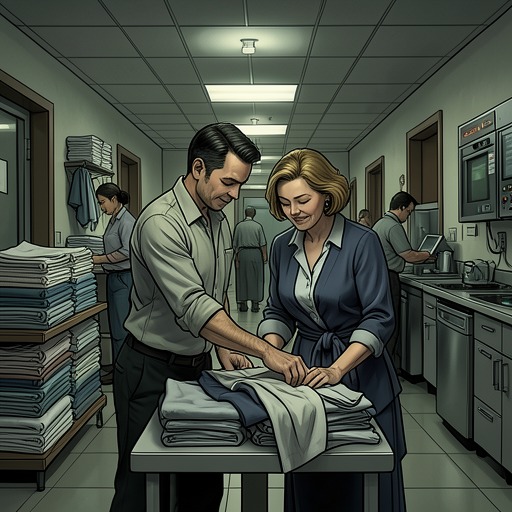
Miranda
Falling For The CEO: BAD BOY ROMANCEMiranda is a Grace Hotel colleague whose ordinary warmth becomes quietly consequential in Diana Jones’s life. Seen first in the staff lounge with her husband Jim Kruger, she embodies a secure, affectionate workplace relationship while also serving as one of the people who recognize Diana’s distress and refuse to leave her isolated. Her humor softens the hotel’s pressures, but her loyalty gives that humor practical force: when Diana’s job and relationship collapse together, Miranda joins the staff effort to protect her.
Identity and Workplace Life
Miranda works at the Grace Hotel and shares the hotel’s demanding service culture, including the expectation that staff maintain a welcoming front for guests. On the first day of a three-day conference, she worries that coffee will not last through the breakfast rush and jokes about having to wear her “how may I help you” smile at the front desk. The detail places her within the emotional labor of hotel work: friendliness is not merely a personal trait but part of the performance required by her shift, even when she is tired or preoccupied.
Her work life is closely coordinated with her marriage. Miranda explains that Carina has allowed her and Jim to arrange their schedules around each other, an accommodation she treats as exceptional rather than guaranteed. Carina has also postponed a meeting with the new general manager so Miranda can settle after returning from her honeymoon. Miranda’s account shows both the practical demands of hotel employment and the value she places on an employer’s fairness when personal and professional obligations overlap.
Marriage to Jim Kruger
Miranda is married to Jim Kruger, and their relationship is presented through playful intimacy rather than formal declaration. When Diana finds them having breakfast in the staff lounge, she teases them about their “intense love.” Miranda answers that it is never too early for Diana to be embarrassed by them and reveals that she had just fed Jim bacon from her own fork. The comic domestic gesture makes their affection visible as a habitual, physical ease.
Jim is quiet and succinct, while Miranda jokes that he has “a way with words,” turning his reserved manner into part of their private humor. He responds briefly to Diana, puts on his white chef’s hat, kisses Miranda, and gives Diana a squeeze on the shoulder before leaving for the breakfast rush. Miranda’s marriage therefore contrasts with the secrecy and mistrust surrounding Diana Jones and William King: it is public, coordinated, and sustained through small acts of familiarity.
Miranda’s history also gives her credibility when she comforts Diana. She tells Diana that Jim asked her to marry him even though she had previously left him to “find myself.” The admission places imperfection inside an enduring relationship. Miranda does not present love as a flawless exchange; she presents it as something capable of surviving mistakes, which allows her to answer Diana’s shame without pretending that damage does not matter.
Friendship and Solidarity with Diana Jones
Miranda is part of the group that knows Diana is in difficulty even before Diana is ready to discuss it. Kate has told the staff about Diana’s situation, and Miranda carefully tests whether Diana understands that her colleagues are aware she does not want help but needs it. When Diana reacts with shock, Miranda makes the staff’s position explicit: they are behind her. Her support is not abstract sympathy; it is a collective promise made within the workplace.
That solidarity becomes concrete after William discovers the concealed overlap between Diana’s employment and their relationship, and Diana spends the morning moving between hurt and anger. She avoids Kate by claiming fatigue and hides in a little-used fifth-floor bathroom before attempting to return to work. At lunchtime, she enters the staff room expecting an ordinary meal and finds almost the entire floor staff gathered there, with Kate, Miranda, and Jim at the front. Miranda is therefore not merely a bystander to Diana’s crisis. She participates in the staff meeting whose purpose is to save Diana’s job, at least temporarily.
Miranda also becomes an emotional witness to Diana’s romantic pain. When Diana admits that William was more than a casual interest and that she has made a mess of both her professional and personal life, Miranda places an arm around her shoulders and reminds her that everyone makes mistakes. The gesture is immediate and physical, but it does not erase the consequences of Diana’s secrecy. Instead, it gives Diana enough social shelter to acknowledge that she genuinely likes William.
Relation to the Hotel’s Service Ethic
Although Miranda is not the principal tour guide, her conversations with Diana belong to the same network of work through which the Grace Hotel creates hospitality. Her front-desk smile, shift negotiations, breakfast routine, and concern for the new general manager’s meeting all reveal the staff as a coordinated system rather than a backdrop for the romance. Their cooperation makes personal care part of the hotel’s daily operation, even as the workload threatens to exhaust them.
Diana’s own recovery is tied to this environment. After her parents’ deaths and the resulting collapse of her studies and friendships, Connor Jones brings her to work at the hotel and asks Kate and the other concierges to train her. Diana gradually discovers that she enjoys communicating with guests, planning trips, and showing visitors Cape Town through its history and culture. Miranda’s presence in the staff lounge helps frame that workplace as a community in which Diana is known not only as Connor’s sister or William’s employee, but as a colleague whose contribution matters.
The contrast between Miranda’s front-desk performance and Diana’s tours is also revealing. Miranda must produce a standardized “how may I help you” smile during a conference rush, while Diana finds renewal in the less mechanical act of seeing Cape Town through guests’ eyes. Together, their roles show two forms of hospitality: one repetitive and regulated, the other interpretive and personally expressive. Both depend on emotional attentiveness, and both are vulnerable to the hotel’s larger pressures.
Character Function and Significance
Miranda’s narrative function is to make workplace solidarity visible. Diana’s secrecy initially isolates her, and William’s discovery converts a private relationship into a professional conflict involving hierarchy, trust, and job security. Miranda helps reverse that isolation by bringing Diana back into a collective structure. Her intervention does not solve the conflict with William, nor does it guarantee Diana’s employment, but it prevents the crisis from becoming a purely private collapse.
She also provides a counterpoint to the story’s damaged relationships. Miranda and Jim have experienced separation, uncertainty, and personal mistakes, yet their present marriage is expressed through coordinated schedules, teasing, shared meals, and physical affection. That contrast gives weight to Miranda’s reassurance: forgiveness and commitment are not sentimental ideals detached from difficulty, but practices carried out after people have failed one another.
Miranda’s importance lies in this combination of levity and action. She can laugh about feeding Jim bacon from her fork, complain about an early shift, and still stand beside Diana when the latter is ashamed, angry, and frightened about her future. Through Miranda, the Grace Hotel becomes more than the setting of a workplace romance. It becomes a social world capable of witnessing damage, organizing help, and offering Diana a path back toward dignity.